
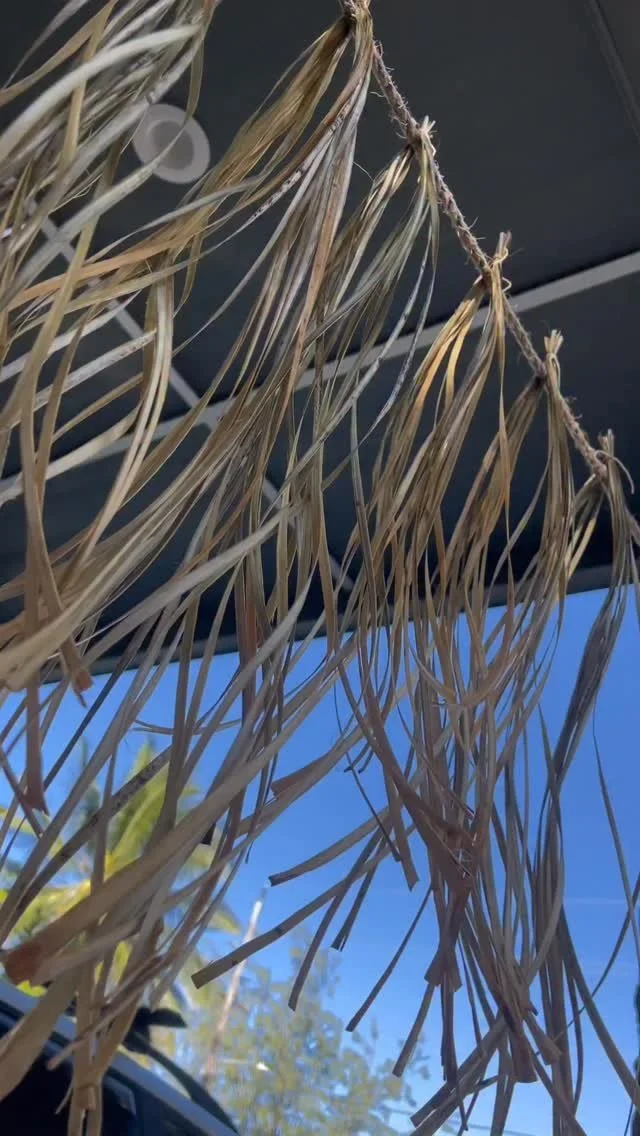
After the whenu have been steeped in the waiwai (tannin water), they are then taken to steep in the mud. This is an iron-rich mud with a very distinct smell and texture. Here in Hawai’i it is called lepo(for us repo means swamp or marsh), and in Aotearoa we call this mud paru. It’s important to share that this process of tannin and mud dyeing is practiced by indigenous cultures all across the world, which is truly amazing.
The tannin reacts with the iron in the mud, producing colours ranging from grey through to deep black, depending on the type of tannin and the mud itself.
What amazes me here in Hawai’i and Im sure in many other islands in the Pacific is that the lo’i kalo (taro terraces) are entirely iron-rich mud. In Aotearoa, paru occurs nears streams and waterways in naturally occurring beds. These sources are somewhat scarce, they aren’t typically large sources, and they are protected by weavers who care for them and ensure they are looked after. So to see these large terraces of lepo is so just amazing to me.
When it comes to leafy weaving fibres like kiekie or harakeke, the waxy outer layer of the leaves makes it difficult for the tannins to penetrate the fibre properly. This can be seen when dying a piupiu where the leafy parts of the strands repels the dye. The underside of the leaf, however, accepts the dye slightly better and for this reason in Maori weaving such as whāriki, kete, and tukutuku — the underside of the dyed leaf faces outward as it has taken the dye better.
Continued in comments⬇️
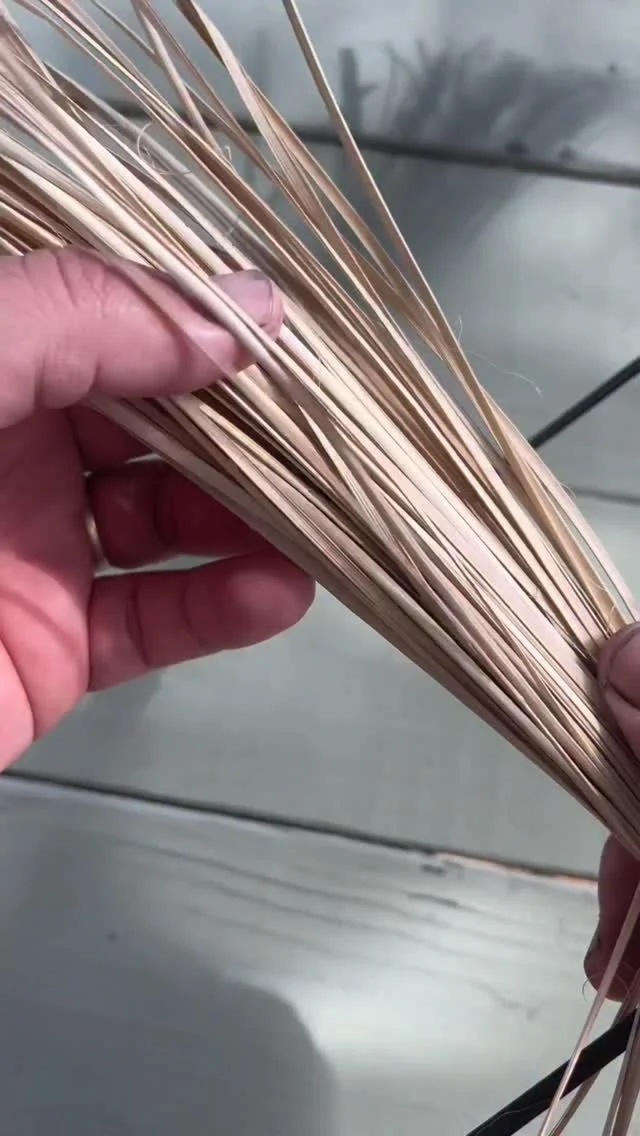
This next video is just a short one. The waiwai(mordant) has been prepared and is ready for the kiekie to be steeped in. I have sorted my kiekie into different colour grades. The unblemished kiekie I have set aside to remain as is. The second grade has yellow discolouration and can be dyed other colours, and the last bunch has significant black spotting. This is what I will be using to dye black in the lepo/paru.
I steep the whenu for short periods, hang it to dry, steep it again, hang it to dry, and so on.
Testing is necessary whenever I introduce new sources into the process or when working in a different area, as all plants and their qualities vary. Doing tests beforehand on a small bunch is important so I can make adjustments to my process before working on a bigger scale. I did my testing the week prior to get the process right, as I hadn’t worked with mangrove and false kamani in this process. Even though my own experience with these plants in other applications, along with conversations with friends, suggested they would be effective, I dont know for sure until the whenu speak.
Understanding the qualities of the materials helps determine things like boiling times, how many batches of leaves are needed, and how long the fibres should remain in the mordant or mud. I sorted all of that out beforehand so that filming could be done in one go, because there is no re-filming. Once it is in the waiwai, it is in the waiwai.
So yeah I test everything. Nature is in constant motion, so things are never exactly the same — the moon, the tides, the seasons and temperature, the cycles of plants and the changes they go through.
When dyeing leaf material like this, the fibres are encased in waxy outer layers, and so, they do not readily absorb dye. For this reason, chemical dyes are predominantly used today in this application, along with heat, to dye the weaving strands quicker and with a wider range of colours. Even then, the process can still be difficult depending on the dye being used.
After the kiekie has soaked up the tannins, it is hung to dry, and then it is ready to be soaked in the mud which you will see in the next video.
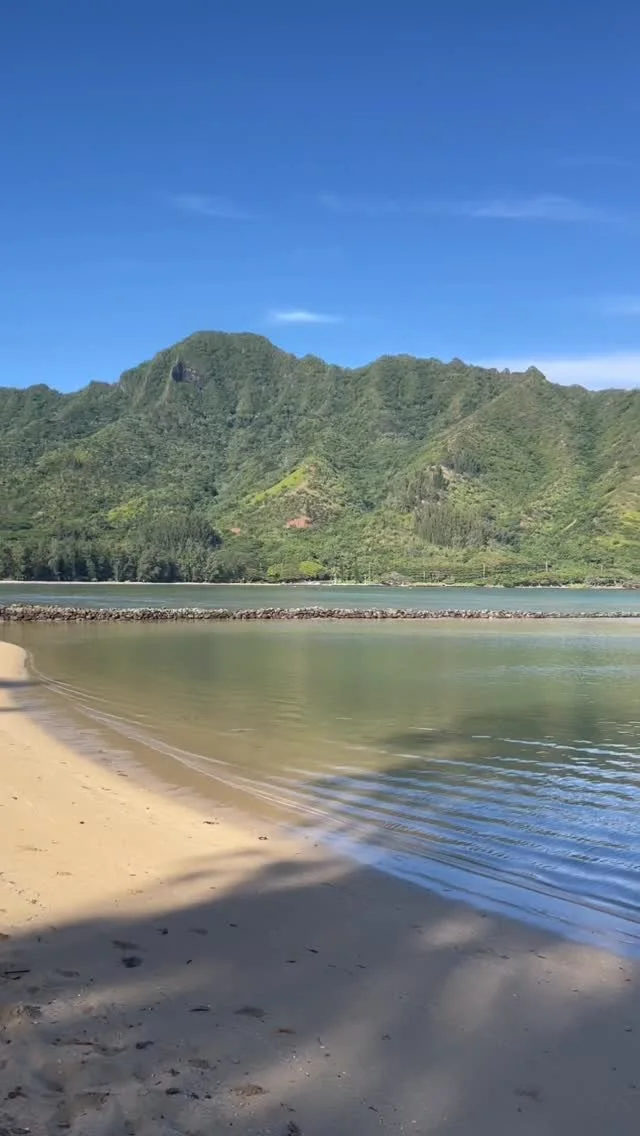
Ok, so here is part one of dyeing: gathering the mordant source and preparing the mordant. Depending on where I am, this process can be quite different, as the dye plants and paru/lepo are always different wherever you go. Even though the overall process remains the same, you often have to adjust certain things to achieve the best results, as some sources are more effective than others. Doing testing on new sources beforehand is a good way to gauge those differences which is what I did prior to this.
Firstly, I have my bunches of sorted kiekie, which are graded by colour. The whitest strands are kept as they are, the slightly blemished ones are my second bunch, and the strands with black spotting are used for dyeing black, so those are the ones I am using in this video.
I am in Hawai’i here in this video, so the plants here are different. I have used other Hawaii plants for this process in the past, but the results were not to my satisfaction, so this time I did more rangahau to source better options. I also discussed my rangahau with friends and narrowed my choices down to the best tannin yielding plants that are accessible to me: false kamani and mangrove. Both are highly invasive trees here, and both happen to produce seeds that float on water and spread easily. Side note, there are alot of plants/trees around that are high in tannins, I have done this process with many different trees over the years using whatever is around.
Continued in comments⬇️
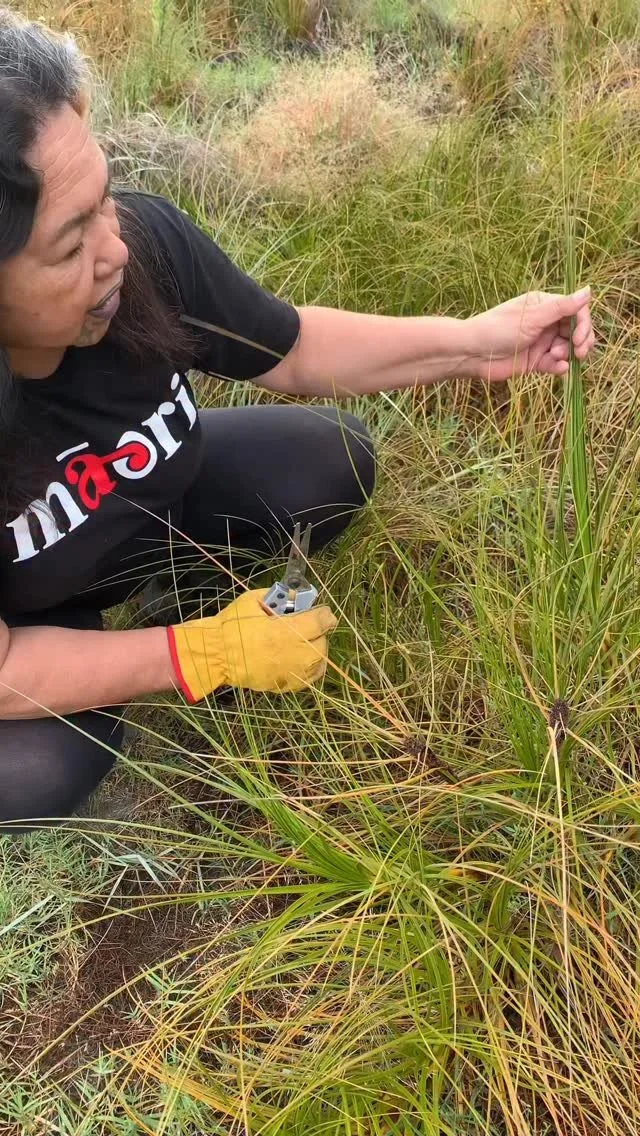
This is my friend Tangimoe Clay, and this is pīngao, a plant tuakana that plays an important role in dune ecosystems by helping stabilise and form sand dunes. Many people may never have seen or heard of it before because it has disappeared from much of our sandy coastlines, despite ongoing restoration efforts.
Tangimoe, who is a renowned weaver, has been deeply involved in the re-establishment of pīngao within her iwi of Te Whakatōhea for more than 20 years. Today it is one of the few places where pīngao is once again abundant and thriving.
What I still find fascinating about pīngao is the way it grows. Beneath the sand are long, rope-like runners that spread horizontally through the dunes, sending up the tufts of green and golden leaves we see above the surface. These golden leaves are a prized weaving fibre used in raranga for kete (baskets), pōtae (hats), whāriki (mats), as well as hieke (rain capes) and many other taonga. I would say however that pīngao is most closely associated with tukutuku, where its bold golden tones create striking contrasts within the patternwork alongside white and black-dyed kiekie.
Concerning harvesting, I’ve been hesitant to share this video because I would not want people to feel they can simply go out and harvest pīngao after watching it. In many places, pīngao is still in decline, and restored areas are carefully protected by kaitiaki(stewards). In many cases, the return of pīngao has come through years of collaborative conservation and community effort.
Because of this, it is important to follow the appropriate tikanga and local protocols when accessing pīngao. The best place to begin building that connection is through becoming involved in planting and restoration work, and by building relationships with both the kaitiaki and the environment itself.
There are different harvesting methods that are obtained through those relationships, and one should not be harvesting pīngao without first learning how to do so properly because you can actually do alot of damage.
Continued below in comment⬇️
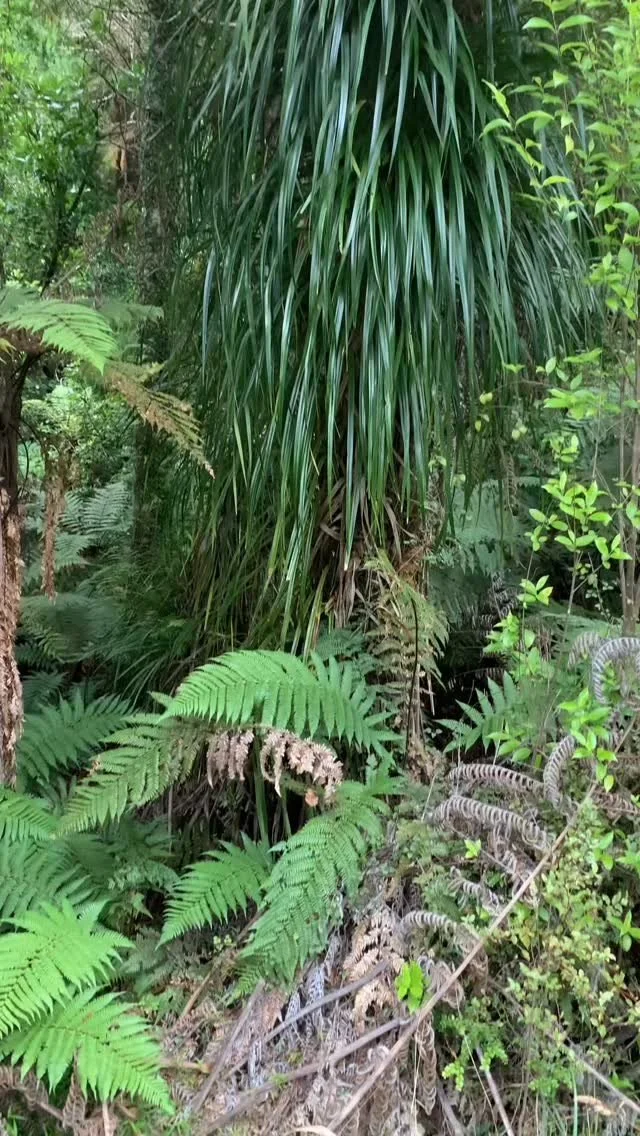
This is a 5 part video, that covers the harvest and preparation of the weaving strands, dying and weaving. I have not included the preparation of the kaho and tautari, which form the lattice as this is already a very long video.
When we think of Māori weaving, the main plant that comes to mind is harakeke (Phormium tenax, NZ flax).
But what many may not know is that our ancestors worked with a wide range of plant fibres across their textile practices.
While much of our weaving typically utilizes one type of plant fibre within a particular weaving practice, tukutuku is unique in that it brings together several plant tuakana within a single practice. I think that is one of the many things that makes tukutuku so special.
The plant tuakana include toetoe (Austroderia richardii), rarauhe (Pteridium esculentum) or tōtara (Podocarpus totara), kiekie (Freycinetia banksii), pīngao (Ficinia spiralis), and of course harakeke (Phormium tenax). Paru (iron-rich mud) is also used in the process to dye weaving fibres black.
To work across this variety of fibres within one kaupapa allows for more time spent in the taiao—observing the diversity of our plant tuakana, the landscapes they inhabit, their unique characteristics, and the tikanga and tukanga that guide how they are gathered and prepared.
When our experiences and learning are broadened, our knowledge deepens. Otherwise, weaving can easily be seen through a narrow lens, particularly in how we understand tikanga and tukanga.
Of course, as with everything, depending on the availability of time and resources, much of this process and knowledge can be cropped out, leaving a very narrow channel for observation and experience. That is a sad reality for me when it comes to weaving.
The more we engage with the taiao, with our tuakana—plant and other—the broader our understanding becomes. Through that, we learn and become better at protecting, caring for, and nurturing our diverse taiao.
Continued in comments⬇️
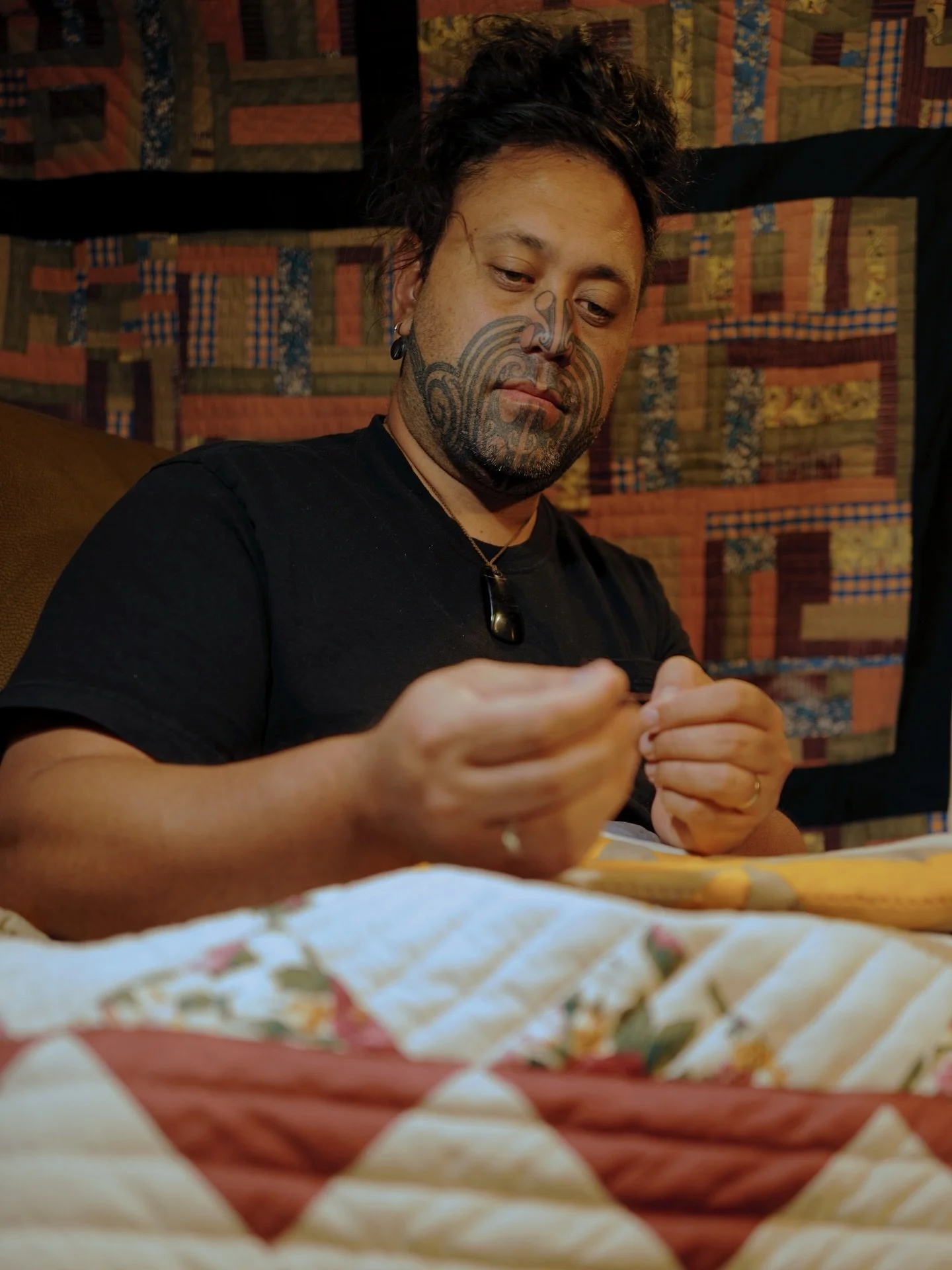
I have always been drawn to quilts and have long resonated with the art form. There is something powerful in taking discarded fabric scraps and irreparable clothing and transforming them into something beautiful — something vital, warm, and comforting.
A quilt is something that can be held onto for a lifetime. Treasured. It carries memories and legacies of family, friendship, and love. There is something deeply moving in knowing that someone held you in their heart and mind with every stitch — that the fabrics themselves once lived a life alongside that person.
I have not personally experienced receiving such a taonga from my tīpuna. Others in my whānau have, and I am truly happy for them.
At some point, we all may feel a pull to prepare a tāonga — to leave behind, reminders of who we are, of our identity and our legacy. Whether in a diary, a recipe book, a song, a jar of seeds, an audio recording, a photo album, a whakapapa chart, a piupiu, a quilt, or even a video showing how to make one.
I know our loved ones will want to know us when we are gone. They will look for us — and perhaps hope to see themselves reflected there too.